
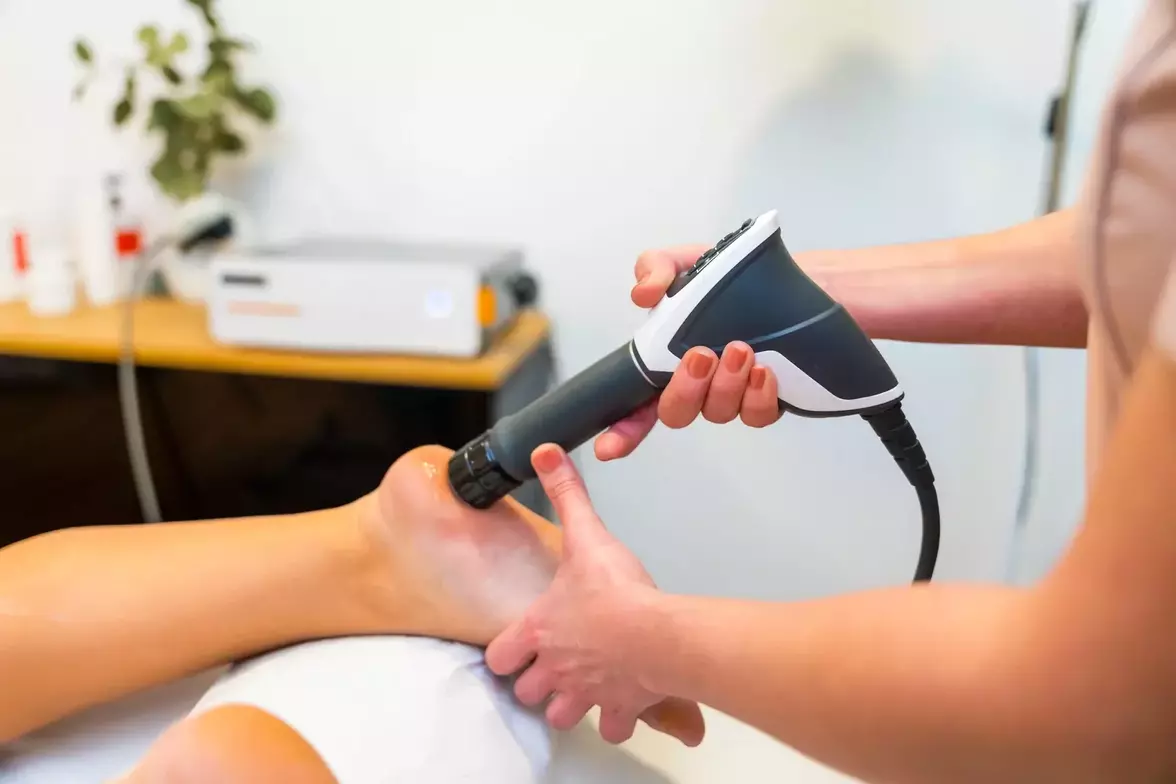
Shockwave Therapy Explained: How It Works, Who It Helps, and Why Technology Matters
Introduction: A Patient Story
Maria is a 52-year-old recreational walker who enjoys beginning her mornings with several miles around her neighborhood. About a year ago, she developed sharp pain in the bottom of her heel, especially during her first steps in the morning and after sitting. She was diagnosed with plantar fasciitis, one of the most common causes of heel pain.
She tried various treatments, including supportive footwear, stretching routines, ice massage, orthotics, night splints, anti-inflammatory medications, massage therapy, and even a course of physical therapy. While some treatments provided temporary relief, the pain always returned. As a result, she began to avoid long walks, and her overall activity level declined. Morning steps remained painful, which affected her ability to stay active, manage stress, and feel like herself.
Plantar fasciitis is a common condition that affects up to 10% of people at some point in their lives. While many individuals see improvement with conservative treatments, a significant number continue to suffer from chronic symptoms lasting six months or longer. When pain becomes chronic, the affected tissue often undergoes structural and biological changes, necessitating consideration of interventions beyond standard care.
Maria eventually underwent shockwave therapy, receiving treatments once a week for several weeks. This was combined with gradual loading exercises and a return-to-walking progression, resulting in a significant decrease in her pain. She regained her morning routine, confidence in movement, and overall quality of life.
Her story illustrates a key principle: chronic musculoskeletal pain often requires treatment approaches that stimulate the tissue’s own healing mechanisms, rather than merely reducing symptoms. Shockwave therapy is one such treatment.
What Is Shockwave Therapy?
Shockwave therapy utilizes acoustic energy to activate biological responses in tissues. It is a non-invasive procedure conducted in a clinical setting and does not require medication, injections, or surgery. This therapy has been used in medicine for several decades, initially developed to break down kidney stones —a process known as lithotripsy. Over time, research has shown that controlled acoustic energy can also promote regenerative effects in soft tissues, tendons, ligaments, and bone.
There are two primary types used in musculoskeletal care:
- Radial Pressure Wave therapy (RPW)
- Focused Shockwave therapy (also called Extracorporeal Shockwave Therapy or ESWT)
Both involve acoustic waves, but they differ in how the waves are generated, how they propagate through tissue, and how deeply they can be targeted. Understanding the difference is key to appropriate clinical application.
Mechanism of Action: How Shockwave Affects Tissue and Pain
Shockwave therapy influences healing through several interconnected biological and neurological mechanisms.
Mechanotransduction:
Shockwaves create mechanical stress in tissues, which cells detect and convert into biochemical signals. This process, known as mechanotransduction, stimulates cellular activity associated with repair. It encourages collagen remodeling, tendon regeneration, and restoration of healthy tissue structure.
Circulation and Neovascularization:
Shockwave therapy promotes the release of vascular endothelial growth factor (VEGF), which stimulates the formation of new capillaries and improves local blood flow. Increased circulation supports tissue repair by delivering oxygen and nutrients while clearing metabolic byproducts.
Neuromodulation and Pain Reduction:
Shockwaves reduce the concentration of pain-related neurochemicals, such as substance P, and alter nociceptor sensitivity. This can decrease both acute pain and the hypersensitivity seen in chronic pain states. The result is often a reduction in pain even before complete structural healing occurs.
Inflammation Modulation and Tissue Remodeling:
Chronic soft tissue injuries are often characterized by disorganized collagen and dysfunctional, low-grade inflammation. Shockwave therapy can shift inflammatory signaling back toward a regenerative pattern and stimulate cells involved in tendon tissue repair. This makes it uniquely effective for conditions where standard “anti-inflammatory” treatments fall short.
Radial Pressure Wave (RPW) vs. Focused Shockwave (ESWT)
Radial Pressure Wave Therapy (RPW)
RPW devices create pressure waves by accelerating a small projectile inside the handpiece. The projectile strikes a transmitter, generating mechanical waves that spread outward in a radial pattern. The highest energy is at the surface, gradually decreasing with depth.
Characteristics:
- Broad, diffuse energy distribution
- Effective for superficial and mid-depth tissues
- Frequently used for muscle pain and myofascial trigger points
- Useful for mid-substance tendinopathies (for example, mid-portion Achilles tendinopathy)
- Generally well tolerated
Focused Shockwave Therapy (ESWT)
Focused shockwave therapy produces a true acoustic shockwave — a high-pressure waveform with a rapid rise time. The wave converges at a specific depth, enabling precise targeting of deeper tissues.
Focused shockwave has several key therapeutic advantages:
- Adjustable energy concentration (energy flux density)
- Control of treatment depth
- Ability to target tissue-to-bone interfaces
- Capability to influence deep tendon, ligament, and bone tissue
This makes focused shockwave particularly useful in chronic conditions that have not responded to superficial treatments.
Different Types of Focused Shockwave Systems
There are three main technologies used to generate focused shockwaves:
1. Electromagnetic Focused Shockwave:
An electric current creates a magnetic field that accelerates a membrane, generating an acoustic pulse. The wave is shaped and directed to a focal point using an acoustic lens or reflector.
- Highly consistent and reproducible energy output
- Depth can be precisely controlled
- Used widely in sports medicine and rehabilitation
- This is the method used by Storz Medical DUOLITH systems
2. Electrohydraulic Focused Shockwave:
A spark discharged in a water medium generates a shockwave that is focused by a reflector.
- Capable of producing very high peak pressures
- Historically used in lithotripsy
- Beneficial for deep or bone-related conditions
- Can be louder and sometimes less comfortable for patients
3. Piezoelectric Focused Shockwave:
Multiple piezoelectric crystals expand and contract to produce acoustic waves that converge at a focal point.
- Exact focal targeting
- Narrow focal zone
- Useful for small, specific structures
- Less commonly used in practices treating larger or diffuse tissue conditions
Clinically, electromagnetic systems are the most widely adopted for musculoskeletal care because they provide strong therapeutic intensity while maintaining patient comfort and precise dosing control.
Conditions Commonly Treated with Shockwave
Plantar Fasciitis
Research consistently supports shockwave therapy for chronic plantar fasciitis. Both RPW and focused ESWT can be effective. Focused shockwave may be preferred when symptoms are long-standing or involve deeper tissue changes.
Achilles Tendinopathy
Mid-portion tendinopathy often responds well to RPW combined with progressive loading exercise. Insertional tendinopathy (where the tendon attaches to the heel bone) often responds better to focused shockwave because the target tissue is deeper.
Patellar Tendinopathy (Jumper’s Knee)
Shockwave can reduce pain and restore tendon health, especially when paired with eccentric strengthening.
Calcific Rotator Cuff Tendinopathy
Focused shockwave therapy has been shown to break down calcific deposits in the shoulder, improving range of motion and reducing pain.
Lateral Epicondylitis (Tennis Elbow)
Both RPW and focused ESWT may be used depending on the tenderness location and tissue depth.
Myofascial Pain
RPW is highly effective for muscle tension and trigger points due to its broad energy dispersion.
Clinician Skill and Treatment Outcomes
Shockwave therapy is not a one-size-fits-all procedure. Outcomes depend heavily on:
- Accurate diagnosis of the pain source
- Correct selection of RPW or focused ESWT
- Appropriate energy dosing
- Treatment frequency and total number of sessions
- Integration with exercise, load modification, and movement retraining
Shockwave alone is often beneficial, but research consistently shows that outcomes are better when shockwave is combined with guided rehabilitation, particularly progressive loading for tendon-related conditions.
Why Storz Medical Technology Leads the Field
Storz Medical is one of the most widely researched and clinically validated manufacturers of shockwave devices in the world. Their devices are used in hospitals, sports medicine centers, orthopedic practices, and rehabilitation clinics internationally.
Reasons clinicians choose Storz:
- Consistent, reliable energy delivery
- Precise control of depth and energy dosing
- Devices designed for both RPW and focused ESWT integration
- Extensive research backing and clinical application history
- Training and clinical support for evidence-based implementation
Consistency matters. In shockwave therapy, the reliability of energy delivery directly affects treatment outcomes.
Conclusion
Shockwave therapy is a non-invasive, research-supported treatment that stimulates the body’s natural healing processes in chronic soft tissue and tendon conditions. It reduces pain through neuromodulation, supports tissue repair through mechanotransduction and improved circulation, and encourages long-term structural remodeling.
Radial pressure wave and focused shockwave are complementary tools, each with strengths that depend on tissue depth and presentation. Optimal outcomes occur when shockwave is integrated into a comprehensive treatment approach guided by clinician expertise.
For many people like Maria, shockwave therapy offers not just pain relief, but a return to movement, independence, and quality of life.
Research References
Gerdesmeyer L, et al. Extracorporeal shock wave therapy for the treatment of chronic plantar fasciitis. J Bone Joint Surg Am. 2008.
Moya D, et al. The role of extracorporeal shockwave in musculoskeletal conditions: Mechanisms of action. Int J Surg. 2018.
Schmitz C, et al. Efficacy and safety of focused and radial extracorporeal shock wave therapy in musculoskeletal disorders: Systematic review. Am J Phys Med Rehabil. 2015.
Rompe JD, et al. Repetitive low-energy shock wave application without anesthesia in chronic plantar fasciitis. J Orthop Sports Phys Ther. 2005.
Notarnicola A, et al. ESWT and tendon pathology: Clinical and biological perspectives. Muscles Ligaments Tendons J. 2012.
Gerdesmeyer L, et al. Radial vs. focused shockwave therapy for plantar fasciitis: Clinical trial results. Clin Orthop Relat Res. 2013.
Ioppolo F, et al. ESWT for calcific tendinopathy of the shoulder. J Orthop Sports Phys Ther. 2013.
Chowdhury SR, et al. Shockwave therapy in plantar fasciitis: Meta-analysis. Clin Rehabil. 2023.

Edward Boudreau
Contact Me


.png)
