
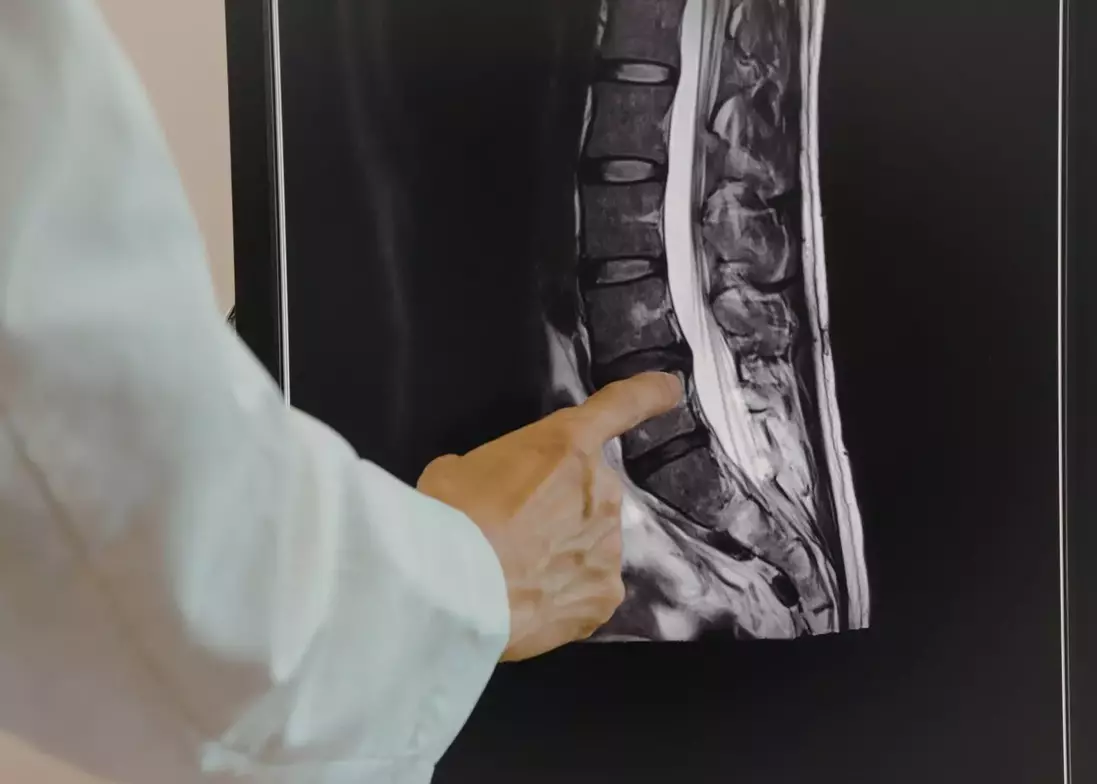
Disc Bulges, Herniations, and "Slipped Discs": What Actually Matters
Few words in musculoskeletal care create more anxiety than "disc bulge," "herniation," or "slipped disc."
Patients often hear those terms after an MRI and assume the scan has found the exact cause of their pain. The story can quickly become dramatic: "My disc is out." "My back is permanently damaged." "I need to be careful for the rest of my life."
This story is understandable, but it is often incomplete and may hinder recovery.
The issue is not that disc findings lack importance; rather, their significance depends heavily on context. Many individuals without any pain have disc bulges, protrusions, and other imaging results. A comprehensive systematic review of asymptomatic individuals revealed that disc bulges and protrusions are common and tend to increase with age. Scans can reveal structural changes in someone who feels perfectly fine, while they might show only modest changes in someone experiencing significant pain.
A disc finding matters most when it fits the rest of the picture — your symptoms, your exam, how things are changing over time. The scan alone is never the whole story.
What a Disc Actually Is
An intervertebral disc sits between two vertebrae. It has a tougher outer ring (the annulus fibrosus) and a softer inner center (the nucleus pulposus). Together, discs absorb load, allow movement, and distribute forces through the spine.
Over time, discs change. They lose some hydration, become less elastic, and respond to load differently than they did years earlier. That is a normal part of aging, not automatically a disease or a source of pain.
When people say "slipped disc," they use a term that does not quite match the anatomy. Discs do not slide out of place. More accurate language is bulge, protrusion, extrusion, or herniation, depending on the shape and extent of displacement seen on imaging. In plain terms, a bulge tends to be broader and more generalized, while a herniation is a more focal displacement of disc material. Some herniations are small and cause no symptoms. Others may press on a nearby nerve, leading to distinct patterns of pain.
What Actually Triggers a Disc Episode
Patients frequently seek an answer to a question they rarely receive: "Why now?"
Disc episodes do not always have a dramatic cause. Sometimes a single event — a heavy lift, an awkward twist — is the clear trigger. More often, an episode develops from a combination of factors that build over time: sustained postures, reduced movement variety, accumulated load, disrupted sleep, or a period of higher stress. The disc or surrounding tissue reaches a threshold, and symptoms appear.
This matters for how you think about recovery. If the episode builds gradually, it is unlikely that a single wrong movement will make it catastrophically worse. And if multiple factors contributed to getting here, then multiple factors can also contribute to getting better — not just resting the spine, but addressing movement, sleep, stress, and overall capacity.
The nervous system also plays a role. When a disc irritates a nerve root, the nerve can become sensitized, meaning it responds more readily and more intensely than usual. That sensitization can make even ordinary movements feel threatening, even when the structural picture is not severe. Over time, appropriate movement and reduced fear help the nervous system recalibrate. Avoidance tends to maintain or worsen sensitization.
Why Imaging Can Mislead
MRI findings are not the same thing as symptoms. Imaging is useful when it helps answer a specific clinical question. It becomes problematic when it is treated as the whole diagnosis.
Guidelines do not recommend routine imaging for uncomplicated low back pain without red flags, in part because incidental findings are so common that they often generate confusion without changing treatment.
This is where many patients get stuck. They receive a scan result without adequate explanation, and the label becomes the diagnosis. They start organizing their lives around the image — avoiding certain movements, catastrophizing about future damage — rather than around the actual pattern of their symptoms and function.
A disc finding matters most when it matches the history and exam. A lumbar disc herniation that irritates a nerve root typically produces radiating leg pain, sensory changes, reflex changes, or weakness in a specific distribution. That is a coherent clinical picture. A bulge on a scan in someone whose pain is local, improving, and mechanically straightforward is a very different situation — even if the imaging language sounds alarming.
Common Misunderstandings
"The MRI found a bulge, so that must be the cause of my pain.
Not necessarily. Disc changes are common, especially with age. The presence of a bulge alone does not prove it is responsible for your symptoms. What matters is whether the imaging finding fits your clinical presentation.
"A herniation means my spine is unstable or permanently damaged."
Usually not. A disc herniation can be painful and limiting, but it does not mean your spine is fragile. Many people improve substantially over time and with appropriate conservative care — often within a few months — without surgery.
"Shooting pain down my leg means serious damage."
Leg symptoms can result from nerve root irritation related to a disc, but symptom intensity does not reliably correlate with the size of the imaging finding. Some small herniations are very symptomatic. Some larger ones cause minimal issues. How you feel is not a direct readout of structural severity.
"I should avoid bending, lifting, and exercise until this is resolved."
This is one of the most common and most costly overcorrections. In an acutely irritable phase, some movements may need to be modified. That is different from avoiding movement altogether. Prolonged avoidance leads to deconditioning, heightened pain sensitivity, and increased fear. Recovery usually requires calming symptoms *and* gradually restoring movement, not choosing between them.
Fear-avoidance: When Protection Becomes the Problem
It is natural to protect a painful area. In the short term, some degree of caution is appropriate.
The problem arises when protection becomes the default mode, when every movement feels like a potential threat, when activities are abandoned "just to be safe", and when the nervous system is in a state of constant vigilance. This is sometimes called fear-avoidance, and it is one of the strongest predictors of delayed recovery in spine pain.
The mechanism is straightforward: avoiding movement prevents you from learning that movement is safe. The brain, never receiving evidence that it can update its threat assessment, maintains or intensifies the pain signal. Confidence in movement does not come from waiting until pain disappears — it comes from gradually accumulating evidence that you can move, load, and function without catastrophe.
This is not about pushing through severe pain. It is about distinguishing between pain that signals genuine harm and pain that reflects a nervous system that has become oversensitive. A good clinician can help you make that distinction and build a plan that moves in the right direction without unnecessarily provoking symptoms.
When to Take a Disc Finding More Seriously
Not all disc findings are equal. Here is a practical framework for thinking about when clinical attention is more urgent:
Higher urgency — seek care promptly:
- New bowel or bladder dysfunction, or saddle area numbness (these can signal cauda equina involvement and require urgent evaluation)
- Progressive or significant leg or arm weakness
- Symptoms following major trauma
- Fever, unexplained weight loss, or a history of cancer alongside new spinal symptoms
Worth a thorough clinical assessment:
- Clear nerve root pattern — radiating pain into a specific part of the leg or arm, with or without numbness, tingling, or reflex changes
- Symptoms that are worsening rather than improving over weeks
- Significant functional limitation that is not responding to basic conservative care
Usually manageable with time and appropriate self-care:
- Local back or neck pain without radiating nerve symptoms
- Symptoms that are improving, even if slowly
- Disc findings on imaging that do not match a coherent nerve root pattern
This is not a substitute for clinical judgment. If you are uncertain, assessment by a qualified clinician is always reasonable. But the framework above reflects how most clinicians think about urgency, and it is very different from the alarm that imaging language often triggers.
What to Do When You Are In The Middle Of An Episode
In the first few days:
Relative rest is reasonable — meaning you reduce aggravating activities, not that you lie still. Continue moving as much as comfort allows. Avoid prolonged positions that provoke symptoms, but do not interpret every ache as a signal to stop entirely.
In the first few weeks:
Gradually expand what you are doing. This does not mean loading the spine to the max or returning to everything immediately — it means building movement tolerance incrementally. Walking is often well-tolerated and useful. Positions and activities that calm symptoms are worth identifying and using, but the goal is to widen the range of what feels manageable, not to stay only in the narrow zone of comfort.
Over the following weeks and months:
The focus shifts to rebuilding capacity — strength, movement variety, and confidence. Structured exercise is among the most effective interventions for disc-related episodes. Sleep, stress management, and staying engaged in normal activities also contribute meaningfully to recovery.
Throughout:
Pay attention to the trajectory. A slow, uneven improvement is still improvement. Symptoms that are broadly moving in the right direction, even with occasional bad days, are a reassuring pattern. The goal is not zero symptoms before resuming normal life, it is restoring function alongside symptom improvement.
The Bigger Picture
Disc findings make the most sense when placed inside a broader model of recovery.
Pain is influenced by more than structure alone. A disc can be part of the story without being the entire story. Fear of movement, deconditioning, poor sleep, and ongoing stress can all amplify and sustain pain independently of what a scan shows. This is not to say the pain is in your head; it is to say that recovery has more levers than imaging language suggests.
Long-term outcomes improve when care is focused on the person: matching treatment to irritability, gradually restoring movement, building strength, improving confidence, and avoiding the trap of organizing a life around an MRI report.
Discs are living tissues inside a complex system. They can become symptomatic. They can also settle down. A scan can provide useful information, but it should never be allowed to define the prognosis.
Final Thoughts
Disc bulges and herniations are real. The symptoms they can cause are real. The anxiety that imaging language produces is also real — and worth taking seriously, because that anxiety can shape recovery just as much as the structural finding itself.
The most useful question is never simply whether a scan found something. It is whether that finding meaningfully explains your symptoms, whether the clinical picture is urgent or manageable, and what steps move you toward better function.
Good care puts imaging in its proper place: useful when necessary, secondary to the clinical picture, and never more important than the person in front of you.

Edward Boudreau
Contact Me


.png)
